c) Andrew Carter, 2022
Even an experienced hiker can have a hike turn out poorly. Sometimes that’s a function of happenstance. Sometimes it’s a function of poor decisions. (Yes, even experienced hikers make poor decisions.) Usually, it’s a combination of both.
I recently tried to hike from Walker Pass east of Bakersfield to Paradise Valley in Kings Canyon National Park. That’s a distance of 163 miles. This is the last California section of the PCT I have to complete in my “thru in two” attempt to hike the entire PCT in 2021 and 2022. I had to skip this section last year due to terrible smoke from fires in Sequoia National Park.
I only made it as far as Trail Pass near Lone Pine. 93 miles. Why? Look at the photo.
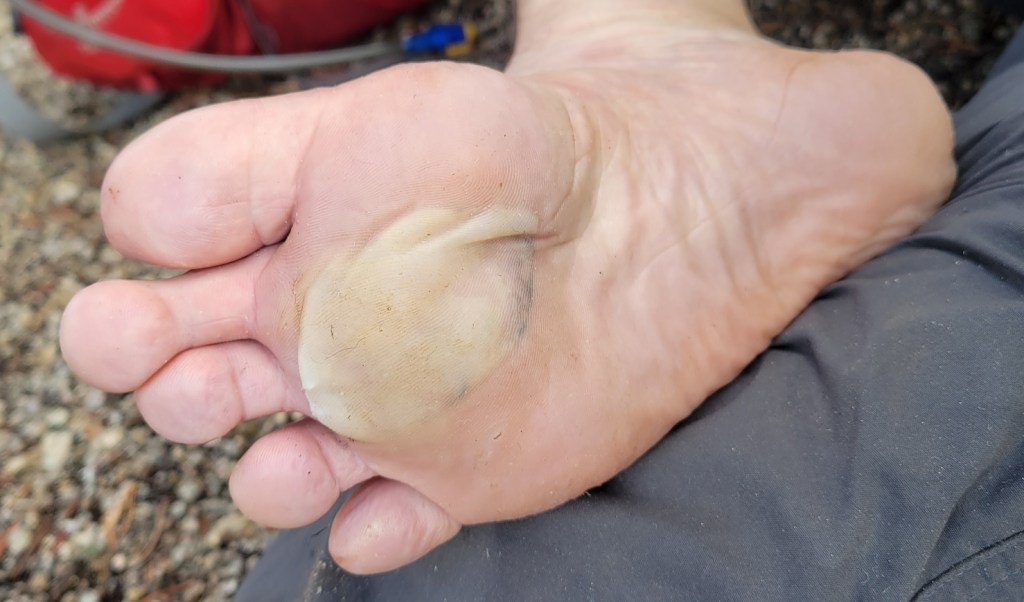
In 60 years of hiking, this is by far the worst blister I have ever experienced. Nothing else comes close.
How did I get it? New shoes. Inadequate cushioning in those new shoes. The half-inch lift I wear in my right shoe because my right leg is one-half inch shorter than my left leg. The lift causes a subtle shift forward in my footstrike, so there is more impact on the ball of my right foot than would normally occur. (I didn’t get a blister on my left foot.) Wet socks from thunderstorms two days in a row. Walking too far, 18-19 miles, that second day with rain.
I had never before thought about the impact of my shoe lift. But it’s true that at the start of many hikes I will get a much smaller blister on my right foot before it has a chance to toughen up. A blister of perhaps 1 inch by 1/2 inch. The blister above is 1-1/4 inches by 2 inches. I don’t tend to get blisters on my left foot.
And no, I’m not going to not use the lift. The back issues I suffered before using a lift were terrible.
Here’s the hiker error in all of this.
First, I keep trying to find the perfect shoe (meaning, lighter weight) instead of sticking with my trusty Merrell Ventilators. That search has led to bad things before — pinched toes once, poor lateral support another time.
Second, I shouldn’t have hiked so far that second day. But there were long distances between water sources, and I like to camp where there is water.
Third, I should have been paying closer attention to my feet. The blister had begun to appear the day before. It hurt some. I put Moleskin on it. Then I didn’t think about it. Big mistake.
Blisters are to some extent a fact of life when hiking, particularly at the beginning of a hike. When I took my shoes and socks off at the end of the next day, I was blown away to see what you see above.
Fourth, I kept walking despite the huge blister. I should have bailed immediately. Instead I walked four more days. To a minor extent that’s a function of how remote the Sierra are and how few the exit points. But mostly it was a function of my driven nature. Persist. Never say die. The result? Sometimes, that will kill you.
Understandably, a hike is no fun when every step carries with it pain. Not crazy debilitating pain. Just persistent ouch, ouch, ouch pain.
But there are other reasons this hike wasn’t that much fun.
At the beginning it was terribly hot, into the mid-90’s. Walker Pass is still the California desert. The Sierra don’t truly begin until Kennedy Meadows, a full three days north. On my second day of hiking, it was so hot I took a 4-hour siesta in the shade from 12 noon to 4:00 pm.
And when it wasn’t hot, it was raining. On parts of three different days I had to hike through the rain. I prefer rain over heat, but I prefer a nice dry cool day over both.
Because this is August of a drought year, water sources were few and far between on my hike which means I had to carry extra water. Usually, I will leave a water source with two liters of water in my pack. That’s 4.4 pounds of water. On this hike, I was usually leaving a water source with four liters of water. That’s 8.8 pounds of water. You feel that extra weight.
I misjudged how much food to carry. I carried too much. I’ve gotten so focused on maintaining my weight while hiking that I forgot I simply don’t have enough appetite at the beginning of a hike to eat all that I should. I have to use up some of my fat reserves before that crazy hiker hunger kicks in.
An add-on to this is that I forgot that one of the effects of hiking at altitude is that your appetite is suppressed. Here’s an explanation from highaltitudehealth.com:
“Leptin is a hormone produced by the body that results in suppression of hunger. When our bodies secrete more leptin our hunger decreases. Multiple studies have shown that when people not acclimated to altitude are brought to higher elevation, leptin increases and appetite decreases.”
Carrying too much food means you are carrying too much weight. When I’m in the middle of a hike, I go through two pounds of food a day. On this hike, I had trouble consuming 1.5 pounds of food a day. Coming out of Kennedy Meadows, I was carrying seven days worth of food. Not consuming 1/2 pound of food per day meant I was carrying 3.5 pounds of excess weight.
On top of this, hikers are required to carry a bear canister to store their food when hiking in the Sierra. My canister, which is the lightest available, weighs 2 pounds, 1 ounce.
Excess weight tires you out, slows you down, and makes hiking less fun. My pack probably weighed 45 pounds coming out of Kennedy Meadows. On most of my hikes, it’s always less than 35.
Finally, I don’t deal well with altitude, anything above 8,000 feet. It takes me about a week to get acclimated.
Lack of oxygen tires me out. I struggle to hike 10 to 12 miles when I would normally hike 14 to 16. At the end of the day, I’m completely blitzed.
Walker Pass is at 5,200 feet. Between Walker Pass and Kennedy Meadows, you hopscotch between 6,000 feet and 8,000 feet. After Kennedy Meadows, as you enter the Sierra, you quickly climb to 8,000 feet and stay above that mark for the next 450 miles. The high point being Forester Pass at 13,120 feet. The high point I reached before leaving the trail was 10,650 feet.
Aching feet; excess water weight, food weight, and bear canister weight; hot temperatures; rain; high altitudes meant that Andrew Carter was not a happy camper on this hike from Walker Pass to Trail Pass.
Let’s hope things go better when I head to Oregon next week to complete the northernmost 650 miles of the PCT. That will take me until late September.
Assuming that goes well, I’ll come back in early October to finish the remaining 70 miles I have in the Sierra. Then, God willing, I’ll be done. Hurray.

 Carter Hikes
Ouch. That blister looked like a tumor. Hang in there. Your approaching the finishing chute. Job well done.
LikeLike
Thanks. Fortunately, it’s already beginning to heal.
LikeLike
At least the blister didn’t get infected. You must have bandaged it with moleskin very well. I have been wondering what you wore as hiking shoes-now I know. I saw a trail marker for Cottonwood Pass. There is a Cottonwood Pass in CO. I was there when 15 years old. Such a great narrative. Keep going!!
LikeLike